The Federal IDR Final Rule changed which disputes are worth filing. Here's what to do first.

For three years, your federal IDR (Independent Dispute Resolution) strategy has been governed by a single, quiet constraint: The arbitration fee was so high that thousands of legitimate out-of-network (OON) claims were never worth disputing.  

That math just changed overnight, and the service lines you wrote off as uneconomical are back in play. This guide shows you exactly what the new Federal IDR Operations Final Rule (CMS-9897-F) changes, why it changes your threshold economics, and the specific steps to take before the fee reduction takes effect. 

How much did the IDR administrative fee decrease? 

The per-party administrative fee for a federal IDR dispute falls from $115 to $15 – an 87% reduction.  

The Departments estimate this reduction from $115 to $15 transfers roughly $504 million annually back to disputing parties. 

That $115 fee existed because the IDR process was drowning. Since launching in April 2022, the system has received more than 5 million disputes,  a volume that vastly exceeded the Departments' original projections and created the backlogs that made a high fee feel necessary. The fee was a rationing tool, and it worked by pricing your smaller claims out of the process entirely. 

Now consider what that meant in practice. At $115 per party, a single low-dollar anesthesia or radiology claim rarely cleared the breakeven line. The fee alone consumed most of the expected recovery. So those claims never entered the queue, not because they lacked merit, but because the arithmetic said no.  

How does the fee reduction change IDR dispute economics? 

Here is the mechanism that matters. Your IDR threshold model is a function of three variables: the administrative fee, the certified IDR entity fee, and your expected recovery net of internal labor. When the administrative fee drops 87%, the breakeven point for a viable dispute drops with it. 

The rule compounds this with a second change: Batching capacity expands from 25 to 50 qualified items per dispute.  

More lines per dispute means the fixed cost of arbitration spreads across twice the claim value. Per-line dispute cost falls on both axes at once. 

Most revenue cycle teams built their "is this worth disputing?" logic when the fee was $115. That logic now excludes claims that have become clearly profitable to pursue. The Departments themselves project a 30% increase in dispute volume driven by exactly this incentive shift. 

There's real money at stake in getting this right. Providers have historically prevailed in a strong majority of IDR disputes, with awards averaging well above the median in-network rate.  

Hospitals spent an estimated $5 billion cumulatively on IDR-related expenses from 2022 through 2024, per Congressional Research Service analysis (Report R48851). The rule doesn't just lower a fee,  it changes the return on a large, existing cost center. 

The key provisions at a glance 

Keep this table close as you brief your team. These are the operational levers the rule pulls. 

Provision

Detail 

Administrative          fee reduction  $115 to $15 per party per dispute, regardless of dispute amount or eligibility outcome. Departments estimate approximately $504 million annually transferred back to disputing parties. Effective five business days after Federal Register publication. 


Batching expansion  Up to 50 qualified IDR items and services per dispute (up from 25). Three permitted configurations: single-patient encounter; same or comparable code across one or more patients; same Category I CPT code range for anesthesia, radiology, pathology, and laboratory services. 


CARC / RARC standardization  Plans and issuers must use specified Claim Adjustment Reason Codes and Remittance Advice Remark Codes on OON remittance. Codes will communicate No Surprises Act (NSA)  scope and IDR eligibility. Code guidance anticipated within six months of publication; applicability no less than four months after guidance. 


Federal IDR Registry  Self-insured plans, health insurance issuers, and FEHB Program carriers must register with the Departments and receive permanent registration numbers – addressing the persistent problem of counterparty identification in OON disputes. 


Open negotiation reforms  Standardized notice form, mandatory portal transmission, mandatory 15-business-day response, timing clarified in business days. 


IDR initiation & eligibility  New attestation requirements at initiation; non-initiating party must furnish supporting documentation for eligibility objections; certified IDR entities determine eligibility within five business days. 


IDR Gateway platform  New centralized platform for dispute initiation, tracking, and management. Phased rollout beginning 2026; full functionality anticipated within 24 months of rule effective date. 


What should providers do now that the IDR fee has changed? 

The $15 fee applies to disputes initiated five business days after Federal Register publication, and the rule itself is effective August 3, 2026. The operational changes phase in on a rolling basis after that. That gives you a narrow planning window, not a long one. Focus here: 

1. Rebuild your threshold ROI models by specialty and service code. Any model built on a $115 fee is now wrong in the direction that costs you money. Rerun the breakeven using the $15 fee and 50-item batching capacity. Where the old rule was "dispute if expected recovery exceeds roughly $X," recalculate X for each high-volume, lower-dollar service line – anesthesia, radiology, pathology, and laboratory first, since those are where the batching configurations and the fee drop combine most powerfully. 

2. Build a batching strategy aligned to the three permitted groupings. The rule permits three configurations: a single-patient encounter; the same or comparable code across one or more patients; and the same Category I CPT code range for anesthesia, radiology, pathology, and laboratory. Map your OON denial inventory to these groupings now. The teams that pre-sort their claims into valid batches will file faster and cheaper than teams batching ad hoc. 

3. Tighten intake and eligibility screening. The rule raises the bar for a properly initiated dispute. There are new attestation requirements at initiation, and certified IDR entities now determine eligibility within five business days. If your intake process lets weak disputes through, you'll burn that fast eligibility clock on claims that were never going to qualify. Screen harder at the front so your filings hold up. 

4. Prepare your remittance tooling for CARC/RARC ingestion. Once code guidance publishes and becomes applicable, plans must use standardized codes on OON remittance to signal NSA scope and IDR eligibility. The Departments estimate this will strip out 146,250 to 219,375 ineligible disputes annually. Position your parsing tools to read those codes automatically, so eligibility determinations become a data step rather than a manual review. 

5. Plan for the IDR Gateway as a transition, not a cutover. Full platform functionality is anticipated within 24 months, with rolling guidance and feature launches beginning in Summer 2026. Treat this as a multi-phase migration. Assign an owner to track each guidance release, because several downstream deadlines – batching operational changes, registry applicability, open-negotiation reforms – are pegged to when the Departments announce specific portal functionality, not to a fixed calendar date. 

Where this gets difficult to do 

None of this is conceptually hard. The hard part is that your team is already at capacity, and this rule asks them to rebuild models, re-map inventory, and monitor a stream of rolling guidance, all at once, and mostly before the changes fully land. 

If you can only do one thing, do the threshold rebuild for your two highest-volume OON service lines. That single move captures most of the recoverable value, because the fee reduction hits high-volume, low-dollar claims hardest. Everything else, including full batching automation, CARC/RARC ingestion, Gateway migration, can follow in sequence once the economic case is proven on those first two lines.

The realistic risk isn't that you'll get the strategy wrong; it's that the guidance will roll out in pieces over 24 months, and a stretched team will miss a functionality announcement that starts a 90-day clock. Someone needs to own that calendar. 

Where EnableComp can help 

Resetting IDR threshold economics across every specialty and service code, and then keeping pace with rolling guidance for the next two years, is exactly the kind of complex-claims work that rewards scale and specialization.  

EnableComp models federal IDR ROI at the service-code level and manages the full dispute lifecycle, so your team captures the newly viable claims without absorbing the analytical and monitoring burden internally.  

If you want a service-line-by-service-line view of what the $15 fee and 50-item batching change for your specific denial inventory, let's build that model for your health system or hospital together.  Reach out today.


About the author 

Gordon Jaye, MPH, MScPM, is the Senior Vice President of Solution Engineering at EnableComp and a Six Sigma Black Belt. He brings extensive healthcare-operations leadership focused on optimizing patient access, patient satisfaction, and front-end revenue cycle efficiency. Gordon  specializes in strategies that improve patient flow, reduce wait times, and streamline intake through technology and process improvement. He is known for driving transformational change with rigorous financial oversight. 
The FTE drain: Why your hardest claims cost more than they collect

Most conversations about revenue cycle performance focus on collections and cash uplift. Those numbers matter, but they only tell you half the story. The other half is what it costs you to assign your in-house revenue cycle team to cases they are ill-equipped to handle – the ones where regulations are constantly changing, rules can vary state to state, and the complexity is far beyond the skills most RCM staff possess.   

When your most capable staff spend their days on the most complex claims, you pay for it in slower cash flow, lower reimbursements, and staff burnout that puts you at risk of losing your best people. The American Hospital Association found that the average hospital assigns 59 full-time employees to regulatory compliance alone, and about a quarter of them are clinicians who would otherwise be caring for patients.  Pulling that much FTE effort into time-intensive, complex claims management instead of patient care just doesn't make sense." 

--> Where your people spend their time matters as much as what they collect. 


Standard workflows clear most of your claims –  a small share quietly consumes your team's valuable time 

Most health systems are built to process routine claims through standard EHR workflows. A smaller share, the complex claims and denials, falls outside that model. These claims often involve third-party liability, coordination of benefits across payers, or payer-specific documentation rules that standard EHR workflows were never built to handle. 

You can see it in how these claims get processed. According to the 2024 CAQH Index, claim submission is now 98 percent electronic, but prior authorization is only 35 percent electronic, and the documentation attachments complex claims require barely reach 32 percent.  

--> The hardest claims are exactly the ones that still have to be worked manually. 

In my experience, the small share accounts for around one-third of a revenue cycle team's time and resources. These claims increase denial rates, delay reimbursement, and divert trained staff from the high-volume commercial work where they add the most value. 


The hardest claims take the longest to pay, which stalls cash flow  

A standard medical claim often settles in about thirty days. A complex claim, like VA disability, takes around 70 days, and some even take months or years to close. That's your most experienced people tied up for weeks on a single claim, and reimbursement timelines extend far beyond those for non-complex claims. 

Your valuable people's time drains away, and cash flow slows to a trickle. The FTE drain doesn’t stop at claims. Complex clinical denials, including DRG downgrades, ED downgrades, medical necessity disputes and coordination-of-benefits issues, carry the same burden, along with the after-the-fact recovery work like zero-balance reviews and post-bill DRG validation.  

Fighting these denials is expensive. Premier estimates the cost of contesting a single denied claim at $57.23 in 2023, up from $43.84 the year before. Labor drives roughly 90 percent of that expense. 

Overloaded specialists burn out, and then they leave 

Skilled revenue cycle staff are hard to find and harder to keep, and the people who can work a complex claim are among the scarcest of all. When you put your team on the most frustrating work day after day, you raise the odds they burn out and leave. 

Administrative load drives a big portion of that burnout. A 36-hospital time and motion study found that documentation was the single largest use of nurses' time, at 35.3% of their shift, ahead of both care coordination and medication tasks. It’s the same in the revenue cycle, where the hardest claims carry the heaviest manual load. 

As a result, retention suffers. In a 2025 Black Book survey of more than 9,000 nurses, 69 percent named documentation burden and poor system usability as major reasons they wanted to leave. Hospitals with high turnover were 3.5 times more likely to be running difficult or outdated systems.  

--> Every hour lost to work better suited to a complexity expert makes it harder to keep the people you can't easily replace. 


5 Signs the FTE drain is already hitting you 

  1. Your best people are on your most difficult-to-resolve claims. Your most experienced staff spend more time on complex claims than on the high-volume commercial work where they recover more, faster.  
  2. Complex claims sit for months. They routinely stall past 60 to 90 days before they move, tying up the specialists assigned to them the whole time.  
  3. Appeals stop after the first round. Your team gives up once the first attempt fails, and recoverable revenue gets written off by default.  
  4. No one owns the complex work. Complex claims aren't a defined function, so the work gets absorbed across the team as it comes in, with no clear accountability or processing strategy.  
  5. Turnover clusters on the hardest claims. The people working on your most difficult claims are the ones most likely to burn out and leave.  

If three or more sound familiar, the drain is already costing you, in cash and in capacity. Working harder on the same claims won't fix it. Start by measuring how much of your team's time complex work actually consumes, then decide which of it belongs in-house and which belongs with a complexity expert. 


The real lever is who works your complex claims 

You can't avoid these high-difficulty claims; they come with caring for patients, and the volume isn't going down. What you can decide is how the work gets done and who does it. 

That turns staffing for this claims segment into a strategic decision, one that directly affects your financial performance. Instead of spreading your team evenly across every claim type, put your people on the work where they recover the most, and bring in experts for the hardest cases. 

Example of how a complexity expert gets to root cause, not just the claim  

Consider a common case. A VA claim gets denied because an authorization never made it into the record. Your in-house associate can appeal and win the payment back, and most operations stop there. A complexity expert goes deeper, tracing that missing authorization back to registration, so the next VA claims don't fail the same way. 

--> By the time a claim is denied or underpaid, the money has already walked out the door, and preventing that loss costs far less than chasing it. 


Turning complexity into control 

Collections tell you what came in. They don't tell you what it cost to get there, or what your best people could have been doing instead.    

This is the problem EnableComp was built to solve. Its approach, Complex Revenue Intelligence™, is designed to uncover hidden revenue, adapt to payer and policy changes, and help revenue cycle leaders act before revenue is lost. It runs on the  e360 RCM platform®, an AI-driven rules engine trained on one of the industry's largest complex revenue cycle datasets, more than 60 million processed claims, and it submits claims electronically about 10 times faster than the industry average. 

It brings more than 25 years of specialized expertise to the same three areas that drain your FTEs: complex claims like VA and workers' compensation, complex denials like DRG and ED downgrades, and revenue recovery like zero-balance review and DRG validation.  

Recovering even a fraction of that FTE drain means more revenue captured and less burnout among the people you can least afford to lose. 

The complex revenue cycle doesn't have to be a constant drain. Learn how EnableComp helps hospitals manage complex claims, denials, and revenue recovery. 


About the author

Zachary Schultz, CSMC, CRCR, is a nationally recognized expert in Veterans Affairs, Out-of-State Medicaid,  and Workers’ Compensation policy and claim reimbursement. As the VP of Solutions Engineering at EnableComp, he maintains relationships with state regulatory agencies, large PPO networks, and payers. He also monitors and analyzes legal developments and legislative changes that impact EnableComp’s business and healthcare partners. Before joining EnableComp, he spent 10 years in operational management roles and served in the US Army, with deployments to Afghanistan for Operation Enduring Freedom. 

Medicaid work requirements are live

What hospital revenue cycle leaders must do before August 2026

Nebraska moved eight months ahead of the federal deadline. By January 2027, every expansion state must follow. 

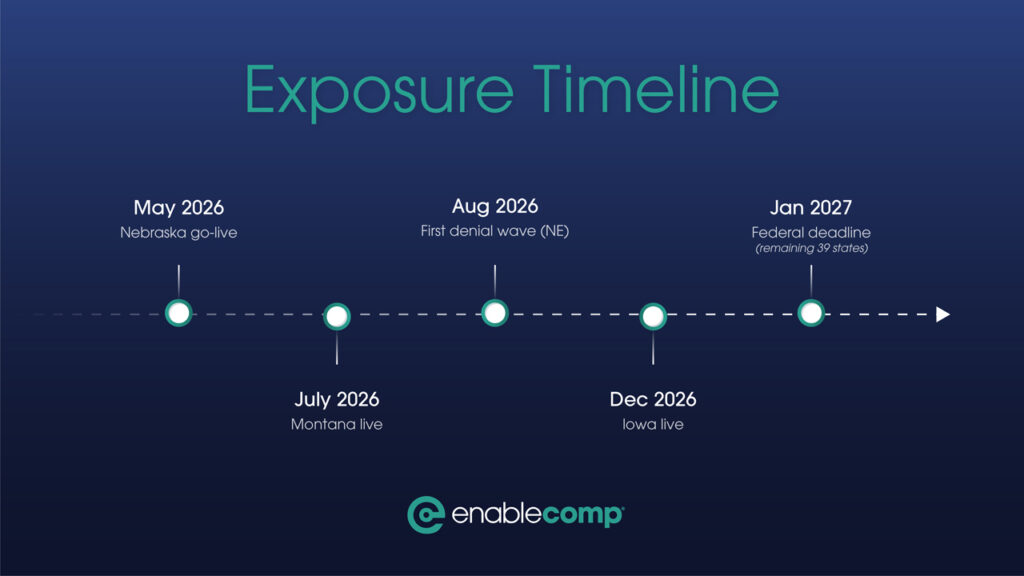
On May 1, 2026, Nebraska became the first state in the nation to enforce Medicaid work requirements, launching eight months ahead of the federal deadline under H.R. 1 – the One Big Beautiful Bill Act.

By January 1, 2027, all 42 Medicaid expansion states and the District of Columbia must follow. That means every state in your Out-of-State (OSS) Medicaid patient portfolio will be affected within the next eight months.

The National Urban Institute estimates 4.9 and 10.1 million people will lose Medicaid coverage in 2028 due to work requirements and more frequent eligibility checks.

Revenue cycle leaders must plan for disruption

For revenue cycle leaders, the question is not whether this will create claim disruption: It will. The question is whether your organization will be positioned to manage the surge in eligibility volatility and OOS Medicaid denials – or be caught flat-footed when the first wave hits in August 2026.

How we got here

Nebraska's path is the product of three forces: a voter mandate, a federal law, and a state choice to accelerate.

In 2018, Nebraska voters approved Medicaid expansion by ballot initiative. Coverage extended to adults up to 138% of the federal poverty level.

In July 2025, H.R. 1 (the One Big Beautiful Bill Act, or OBBBA) was signed into federal law. It required all 42 expansion states and DC to implement community engagement requirements by January 1, 2027.

In December 2025, CMS approved Nebraska to launch eight months ahead of the federal deadline, effective May 1, 2026.  The requirements apply to new applicants as of May 1st and existing enrollees will be assessed at first renewal on or after July 31, 2026.

The Urban Institute projects that 16,000 to 30,000 Nebraskans will lose coverage by 2028 out of the roughly 70,000–72,000 subject to the requirement. Many will lose coverage not because they are ineligible, but due to administrative failures such as missed paperwork, enrollment system friction, and lack of awareness.

The requirement applies only to the expansion population.

Qualifying activities

Who is exempt

Temporary hardships can also apply. These include hospitalization, residence in a federal emergency declaration county, or residence in a high-unemployment county.

The state estimates it can auto-verify 60% to 70% of affected members using existing data. The remaining 30% to 40%, roughly 21,000 to 28,000 people, must submit verification or declaration forms. Non-compliant members get 30 days to respond before disenrollment.

The August 2026 inflection point

The first material disenrollment activity in Nebraska will hit the cohort whose annual renewal periods end July 31, 2026. This means:

Where the financial pressure hits

For hospitals and health systems, the financial exposure operates on these timelines:

Immediate: Now through July 2026

The first phased renewal cohort, with end dates of July 31, 2026, will start showing up in claim data in August. Self-pay conversion and denial rates will drift before most teams have a clean baseline.

Phased rollout: August 2026 through June 2027

As existing enrollees cycle through their renewal months, eligibility losses spread across the year. That makes the trend harder to spot in any single month's denial report. Cohort-level segmentation is the only way to see it clearly.

National: By January 2027

Every expansion state in your patient mix becomes a source of disenrollment risk. Montana goes live in July 2026 and Iowa follows in December. The remaining 39 expansion states must launch by January 1, 2027.


Financial exposure for providers

The Nebraska Hospital Association reports that roughly 30% of Nebraska hospitals already operate without a sustainable margin. Bluestem Health, a Lincoln FQHC, has modeled $400,000 to $600,000 in additional annual losses. These are not abstract projections; they are direct hits to uncompensated care, charity volumes, and bad debt.

Not all providers will feel this equally. Beyond those impacted in Nebraska, the institutions most at risk in the near future are those with OOS Medicaid volume concentrated in states adjacent to early-adopter states.

Nebraska’s six bordering states – Iowa, Kansas, Missouri, Wyoming, Colorado, and South Dakota – represent the near-term exposure concentration. Hospital partners in these states that draw patients from Nebraska for trauma care, tertiary referrals, or specialized services will encounter the first wave of coverage disruption.

Structurally, the highest-risk providers share a common profile:

Critical access hospitals in border counties where patients routinely cross state lines for care.

As the January 2027 national deadline approaches, this exposure will broaden to every health system with any OOS Medicaid volume.

The doubled redetermination problem

Work requirement disenrollment is the most visible risk, but it is not the only one.

H.R. 1 mandates six-month redeterminations for the Medicaid expansion population – down from the typical 12-month cycle. This change doubles the frequency at which eligibility status can change for any given patient. For revenue cycle teams managing OOS claims, this means:

Operational impacts to providers

Work requirements shift much of the operational burden onto providers. When enrollees churn off coverage, even briefly, hospitals and clinics absorb the verification work, the care gaps, and frequently the unpaid bills. These four pressure points stand out:

1. Emergency department exposure

Many enrollees first present at the ED, and weeks-long enrollment windows leave hospitals absorbing costs when coverage lapses between visits.

2. Patient navigation burden

Many providers will absorb the front-end work of explaining requirements, documenting exemptions, and assisting with iServe submissions. NHA estimates 30%–40% of the 70,000 affected enrollees will need manual hour verification.

3. Continuity-of-care disruption

Coverage churn creates gaps in chronic disease management (diabetes, behavioral health, HIV, hemophilia) and care-plan execution.

4. Rural capacity strain

The Nebraska Rural Health Association notes already-understaffed rural hospitals would face the largest relative volume of disenrolled patients.

Actions revenue cycle leaders should take now

Revenue cycle leaders should be taking the following actions now, before the August 2026 denial wave begins.

Audit your OOS Medicaid exposure by state

Identify what share of your OOS Medicaid volume comes from Nebraska, Montana, Iowa, and the states adjacent to them. Quantify the AR exposure. This is your baseline for measuring impact and prioritizing response right now.

Stress-test your time-of-service eligibility processes

The primary failure point in work requirement environments is coverage that was active at the time of service but lapsed before billing. Front-end eligibility checks need to account for the six-month redetermination cadence and flag patients in OOS expansion states as elevated-volatility accounts.

Verify OOS provider enrollment is current in affected states

Work requirement disenrollment creates a secondary enrollment problem: Patients who lose and then regain coverage may do so under a different Medicaid managed care plan or fee-for-service pathway. Ensuring your organization maintains current provider enrollment across all OOS Medicaid programs is foundational to collecting on this volume.

Build denial response workflows now, not after August

OOS Medicaid denials for coverage loss require a different response than standard billing denials. Teams need clear protocols for retroactive coverage investigation, coordination of benefits review, and self-pay conversion workflows for patients who are permanently disenrolled.

Other impacts to anticipate

Beyond the clinical disruption, work requirements reshape the financial mechanics of serving the expansion population. Three areas warrant early attention:

  1. Self-pay and bad debt growth following coverage loss, particularly during the July 2026–June 2027 phased renewal window.
  2. Higher charity care and counseling demand. Expect added FTE pressure on patient access and financial counseling teams.
  3. Mid-AR coverage status changes will become significantly more common.

How EnableComp can help

As Medicaid eligibility becomes more volatile under H.R. 1, the revenue at greatest risk isn't always where hospitals are looking. OOS Medicaid claims – already among the most complex to enroll, bill, and collect on – get harder still when patients are cycling on and off coverage in their home states.

EnableComp’s signature Complex Revenue Intelligence™ approach and e360 RCM® platform are purpose-built to recover dollars many organizations write off.

For hospitals and health systems preparing for the August 2026 redetermination window and the January 2027 federal deadline, here a few areas where we can help right now:

The August window is three months away. Let's start with your OOS Medicaid exposure today. Talk to an EnableComp Expert (link).

About the Author. Gordon Jaye, MPH, MScPM, is Executive Director of RCM Policy and Industry Engagement at EnableComp. He has spent his career at the intersection of healthcare policy and revenue cycle operations, including leadership roles at Orb Health, Wishard Hospital, and Eskenazi Health.
This article summarizes publicly available information from reputable government, news, and industry sources. It is provided for general informational purposes and is not legal, financial, or compliance advice.